Wednesday, June 30, 2010

The Grace of the World


One of my favorite Wendell Berry poems, "The Peace of Wild Things," follows.

When despair for the world grows in me
and I wake in the night at the least sound
in fear of what my life and my children's lives may be,
I go and lie down where the wood drake
rests in his beauty on the water, and the great heron feeds.
I come into the peace of wild things
who do not tax their lives with forethought
of grief. I come into the presence of still water.
And I feel above me the day-blind stars
waiting with their light. For a time
I rest in the grace of the world, and am free.


Many of us find our peace in places of natural and wild beauty. Summer in particular is a season to spend some time in wild places through a hike, a boat trip or kayaking, cycling or running. Even sitting on a beach and looking out into the ocean, a pond or a lake can feed our souls.

The key is to find those places where you can "rest in the grace of the world" as Berry puts it. Such places abound if we would open our eyes to the beauty around us and within us.

Tuesday, June 29, 2010

In Praise of A.A.


A column by David Brooks in today's New York Times titled "Bill Wilson's Gospel" reminded me once again of the good things about Alcoholic's Anonymous. Here's the link to the article: http://www.nytimes.com/2010/06/29/opinion/29brooks.html?src=mv&ref=homepage.

Brooks writes, "In a culture that generally celebrates empowerment and self-esteem, A.A. begins with disempowerment. The goal is to get people to gain control over their lives, but it all begins with an act of surrender and an admission of weakness."

In other words, A.A. is counter intuitive. It is based on a paradox that is also at the heart of the Christian faith: in powerlessness is true strength. To surrender ourselves to a Higher Power is to become empowered in deep and powerful ways.

What most impresses me about A.A. is that it lays out a program to transform your soul. The byproduct of this transformation is to gain control over your addiction. Yet, the thrust of A.A. is the salvation of one's soul. The result is deep and lasting moral and spiritual changes.

The evidence of this spiritual transformation can be found in the twelfth step: to help others embark on this same spiritual path. The remarkable genius of A.A., like the genius of Christianity, is its proclamation that the way to abundant life is through weakness and powerlessness.

Monday, June 28, 2010

Above the Clouds


I spent the last night of my Machu Picchu trek at Phuyupatamarca, an Inca word meaning "place above the clouds." We camped at 11,500 feet in elevation and looked down on a cloud rain forest. The photo above is of clouds spilling over the mountaintop.

Being above or within clouds is a mystical experience. There is something magical in being close enough to clouds that you can touch them. Several of my fellow trekkers commented on how awesome it was to look down on a sea of clouds spilling over the mountains as if being poured out of a bowl.

The next morning, we hiked up to a high place to watch the sunrise on Salcantay, a sacred mountain to the Incas. Our guide had each of us take three coca leaves, say a prayer and blow on them three times. This ancient ritual was moving when framed against the first rays of light on the high, snow-capped mountains. The photo below shows what we saw.


Ancient peoples expressed gratitude and awe at the sunrise and sunset, as well as many other wonders of the natural world. There is something so right and so very human about continuing this tradition.

Friday, June 25, 2010

Summer Reading


The phrase "summer reading" evokes images of relaxing with a good book on the beach--reading for pleasure and/or entertainment. Mass market paperbacks are the stock and trade of publisher's book lists in the summer.

However, because I'm teaching a course on the Old Testament in the fall, I am reading the primary textbook, Reading the Old Testament by Larry Bandstra, this summer. In addition, I will be reading several other books on the same subject. Not exactly light reading.

In my reading yesterday about the creation story in Genesis, I came across this provocative sentence:
"The Primeval Story beings with a world-class road trip, a space-time adventure that sweeps us back to ultimate origins... The narrative takes us to the earliest conceivable moment, the cosmic beginning, where we witness the formation of a universe."

Suddenly, my imagination was jolted to life and I began to think about the beginnings of the universe. What an amazing thought: our universe began in a specific moment! This beginning is steeped in majesty and mystery. Bandstra is right in calling it a "space-time adventure." Only through imagination can we enter into this story at its first moment.

My point in sharing this is that even in the driest, densest textbook, there is the possibility of a fresh and creative word being spoken that evokes something deep within us. "The beginning of our universe is an adventure that is still continuing." I could ponder this thought for the rest of the summer, or longer...

Thursday, June 24, 2010

Down from the Mountaintop


Having enjoyed several days on mountaintops in the Andes, I'm now back on the plains of daily life. Mountaintops are wonderful places. On a summit you are high above the surrounding scenery and have great vistas. This "top of the world" feeling is thrilling.

No wonder we call spiritual highs "mountaintop experiences." No matter where you are located, a mountaintop experience is one of deep mystery and meaning. Such experiences nourish and inspire our souls. These direct encounters with the sacred dimension of life are energizing and transforming.

A mountaintop is a great place to visit, but we can't stay there too long. At some point, we need to descend from this high place to the plains of everyday life. Life is not lived on mountaintops, but on the plains (and sometimes the valleys) of daily life. Moses came down from Mt. Sinai. Jesus, Peter, James and John came down from the Mount of Transfiguration. Mountaintops are way stations on the journey of life.

Yet, the memories of our mountaintop experiences can sustain us and inspire us in our daily life. They remind us of times of intense spiritual connection where God seems so near that we can reach out and touch the Divine presence. We need to cherish these rare moments while realizing that they are so precious because they are rare. Happy climbing-- and happy descending!

Tuesday, June 22, 2010

Dark Constellations


On a clear night many stars become visible. For centuries, the brighter stars have been grouped into 88 constellations. As children, we learn their names: the Big Dipper, the Little Dipper, Scorpio, Leo, and so on. For children, identifying constellations is a fun game.

On my recent trip to Peru, I learned that the Incas had a category of constellations very different from the groups of stars we call constellations. They had "dark" constellations in which the space between the stars was emphasized. With the help of our guide I was able to see the dark Llama constellation next to the Southern Cross. The Incas also saw a fox and snake in the dark spaces between the stars.

The concept of dark constellations serves as a reminder of the importance of where we focus our attention. We can be so focused on the brightness of lights that we fail to see the fuller view. Physicists claim that "dark matter" makes up most of the universe. Yet, we can't "see" this mysterious kind of matter.

Dark constellations is a powerful metaphor for the spiritual life. While the "lighter" spiritual values of love, joy, and hope often capture our attention, we also need to pay attention to the "space" between these. An important need of the spiritual life is to create space within us-- a kind of emptiness that is open and receptive to the sacred dimension. For when we are empty there is the possibility of being filled.

Monday, June 21, 2010

A Peruvian Pilgrimage


I just returned from an amazing 6 day hiking trip in Peru. The first 5 days involved high altitude hiking above 13,000 feet and the last day focused on a 4,500 foot descent on the Inca Trail to Machu Picchu.

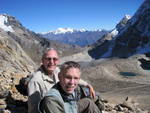
Although the famous ruins at Machu Picchu was the goal of this trip, the journey to MP was equally stunning. We took in awesome views of Salcantay, a peak of 20,000+ feet and sacred to the Incas. We hiked down a scenic valley filled with Llamas, sheep, cattle and Andean dwellings. We hiked up and over Salcantay saddle which was 16,000 feet in elevation (the photo above is of me and a fellow hiker on the saddle--I'm the one in back).

This journey fit the classic definition of a pilgrimage: a sacred journey to a sacred place. In a pilgrimage, the journey is as important as the destination. Throughout this journey, I and my fellow trekkers expressed awe, wonder and gratitude at the magnificent beauty of Andean Peru. We were overwhelmed by the brilliant night sky and the stunning sunrises.

I learned that the Inca people believed that all aspects of creation were infused with sacredness: mountains, rocks, trees, stars and, of course, the sun. After walking in their footsteps, I can readily identify with this belief in the sacredness of all creation. We don't need to go on a Peruvian pilgrimage to experience the divinity of the natural world, but the value of a pilgrimage is that it takes us away from our normal routines and enables us to see things from a fresh perspective. I returned home deeply grateful for this wondrous journey.