News of the death of the great Irish poet, Seamus Heaney, on Friday reminded me of a line from one of his poems that has stuck with me over the years. I can't remember which poem it is in, but I can't forget the line: "How perilous it is not to live the life you've been shown."
Like all great poets, Heaney expresses the essence of deep and great issues of human life in a few simple words. With these few words, he captures the concept of vocation. A vocation is usually expressed in the auditory term "calling." We feel or hear a sense of being called to a particular profession or to a specific way of life. An example of the latter kind of calling is John Wesley's contention that all Christians are called to a single vocation capture in the word "love."
Heaney's brilliance is that he puts the vocational issue in terms of sight or insight. When we've been "shown" the path we should walk in life, it is dangerous not to take that journey. Our world is filled with persons who have listened to the wrong voice and are living diminished lives as they suffer in working at a job they hate. In other words, they are not living the life which they have been shown.
How do we "see" our vocations? Each person must answer this question for him or herself. A vocation can come out of a spiritual quest or it can come out of working at something that is deeply fulfilling. However, once we have "seen" what we are called to be and do, we ignore this vocation at our peril. Fortunately, even though Heaney is gone, his words endure.
Monday, September 2, 2013
Monday, July 8, 2013
Gratitude For the Office?
A colleague dropped by my office a few minutes ago. I asked how his 4th of July holiday weekend went and he said, "It was wonderful. I enjoyed every minute." I commented that all this enjoyment ended with coming back to the office on Monday morning. He then said "We are so fortunate to be in a place that has electricity, air conditioning, indoor plumbing and where we don't have to worry about Malaria."
To be thankful about being back in the office on Monday morning is a genuine expression of deep gratitude. It's easy to be grateful for leisure time and for good food, drink and company. Yet, true gratitude encompasses all dimensions of life: work as well as play, difficulties as well as joys, defeats was well as victories.
It's not that we are grateful for everything that happens to us. Giving thanks for cancer, violence or hatred doesn't make much sense. However, I believe we can be grateful in every circumstance. Gratitude is an inner perspective on what happens to us and to our world. Seeing life through the eyes of gratitude can be transforming.
So I'm going to work on cultivating a deeper and more persistent gratitude. I want to be able to give thanks in all circumstances and to have a gratitude that will stand up to defeat, disappointment and failure. I want to be able to be grateful even when I don't feel grateful.
This deep and resilient gratitude comes from believing that all of life is a gift, even the parts of life we don't like or enjoy. To be gratefully alive is to be able to affirm this giftedness of life. Gratitude isn't only about counting our blessings, but being thankful for the lessons taught by pain, disappointment and deprivation.
To be thankful about being back in the office on Monday morning is a genuine expression of deep gratitude. It's easy to be grateful for leisure time and for good food, drink and company. Yet, true gratitude encompasses all dimensions of life: work as well as play, difficulties as well as joys, defeats was well as victories.
It's not that we are grateful for everything that happens to us. Giving thanks for cancer, violence or hatred doesn't make much sense. However, I believe we can be grateful in every circumstance. Gratitude is an inner perspective on what happens to us and to our world. Seeing life through the eyes of gratitude can be transforming.
So I'm going to work on cultivating a deeper and more persistent gratitude. I want to be able to give thanks in all circumstances and to have a gratitude that will stand up to defeat, disappointment and failure. I want to be able to be grateful even when I don't feel grateful.
This deep and resilient gratitude comes from believing that all of life is a gift, even the parts of life we don't like or enjoy. To be gratefully alive is to be able to affirm this giftedness of life. Gratitude isn't only about counting our blessings, but being thankful for the lessons taught by pain, disappointment and deprivation.
Tuesday, April 23, 2013
The Benefits of Church-Going

Did you know that weekly church attendance has been scientifically linked to lower blood pressure, a strengthened immune system and can add up to three years to your life span? So contends an April 22 New York Times blog by T.M. Luhrmann.
Luhrmann speculates on the reasons for the health benefits of church attendance and comes up with several. First, being a part of a community has social benefits. This is especially true in a faith community with the mission of helping others. Secondly, healthy behavior is encouraged in religious communities. As the Dali Lama once said, "The purpose of religion is to make us better persons."
However, her the third reason she cites is the most intriguing. Because God is immaterial, she contends that those going to church are encouraged to conceive of God as personal and real. Therefore, religious persons can have a personal relationship of love and trust with God. While she admits this way of visualizing God may work in a similar way to the "placebo effect," she nonetheless argues that it is powerful and even transforming.
Religion at its best can make our lives healthier and better. However, Christians follow a Jesus whose spiritual path led him to suffering and death. The paradox at the heart of Christianity is that when we give of our lives for others, we receive a fuller and more abundant life.
I don't believe we ought to "sell" church-going as a cure for physical, emotional or social ills. At the same time, I do believe that connecting with the sacred dimension of life will make our lives fuller, richer and better. And, when suffering does come, we have a community and a God who walks this journey with us.
Friday, September 28, 2012
Lessons From the Book of Job
In the "Wisdom Literature" course I'm teaching this fall, we have just finished reading and discussing the Book of Job. Job is a righteous person who loses nearly everything: his wealth, children, and health.
At first, Job patiently accepts these losses with equanimity, saying, "The Lord gives and the Lord takes away. Blessed be the name of the Lord." However, when his three friends tell him that he must have done something wrong to cause his suffering, Job offers a strident defense of his innocence.
Job also wants answers from God as to why this is happening to him, a good and moral person. First, he asks for a meeting with God and then wants a trial in which he and God can plead their cases to be judged by someone neutral. Finally, Job rails at the injustice of God and questions God's goodness.
When God finally does speak, God doesn't answer Job's questions. Instead, God asks Job a series of rhetorical questions that cowers Job into silence.
The story of Job doesn't answer the question of why the innocent suffer. Rather, Job portrays a relationship with God in the midst of innocent suffering. Job rails at the injustice of his suffering. He gets angry with God and tries to provoke a confrontation with God. Yet, he never gives up on God and God never abandons Job.
Like Job, there is unjust suffering in our world and we are sometimes victims. Job teaches us that it is ok to question, challenge and even become angry at God. God is big enough to take our anger.
In any relationship, there are times of difficulty and stress. This is also true of our relationship with God. The key is to remain in relationship until the issues can be resolved.
Tuesday, July 17, 2012
Taking Great Chances
An essay by Steven Petrow in today's New York Times caught my eye. The essay was titled "New Cancer Threat Lurks Long After Cure" and dealt with "secondary cancers." These cancers are caused by the radiation and chemotherapy treatments for an initial cancer.
Mr. Petrow contends that cancer survivors go in one of two directions. Some are stalked by anxiety, depression or post-traumatic stress disorder. Others experience higher self-esteem, a greater appreciation for life or a deepened spirituality.
He cites late Senator Frank Church, a cancer survivor who wrote that survival led him to live life more fully:
Life itself is such a chancy proposition that the only way to live is by taking great chances.
Senator Church followed his own advice and became an avid environmentalist and led a life of doing good whenever and wherever he could.
I agree with Senator Church up to a point. I think taking risks in life can lead to more fulfillment and satisfaction. However, I don't think all chances have to be "great." Even taking small risks like speaking to a stranger or doing an unexpected kindness for someone can lead to a more satisfying life.
Another way of putting this is to get outside of your comfort zone. Trying new things and doing things that are unfamiliar often require us to go beyond what is safe and comfortable. Doing this leads to growth and growth seldom happens without risk or difficulty.
Fortunately, I haven't had to deal with cancer. Yet, I think Senator Church's advice is good for those of us who don't have a life-threatening illness.
Labels:
comfort zone,
fulfillment,
risks,
satisfaction
Thursday, May 31, 2012
Nature Deficit Disorder
When I was an adolescent growing up in Albuquerque, NM, I spent most of my waking hours outdoors. I loved to take long walks in what we called "the mesa," which was actually the upper sonoran desert that began at the end of our street. On Saturdays, I would hike in the foothills of the Sandia mountains, which were about two miles from home. As a Boy Scout, I spent one weekend a month on a camping trip that usually involved backpacking.
This way of life is now gone. Children and adolescents spend most of their time indoors looking a computer screens or TV's. Adults, too, spend most of their working hours and leisure time indoors. As a result we suffer from Nature-Deficit Disorder. The symptoms of NDD are obesity, depression and a lack of spiritual connection.
It's the lack of spiritual connection that I'm concerned about. I find it difficult to imagine a rich and full spiritual life without spending time in the beauty and sacredness of nature. My soul is fed by early morning rows on the Norwalk River and weekly hikes in Devil's Den Nature Conservancy, as well as sitting on our front porch reading.
In his book The Nature Principle: Human Restoration and the End of Nature-Deficit Disorder,Richard Louv writes:
Louv has hit the nail on the head. If we want to experience awe and wonder, then we need to discover places that evoke these sacred emotions in us. For me, this sacred place is outdoors in the God-created world. Being there leads me to connect with it's Creator. The photo above, taken in Nepal, symbolizes the sacredness of nature by showing a "stupa" (shrine) against the background of the Himalayas.
This way of life is now gone. Children and adolescents spend most of their time indoors looking a computer screens or TV's. Adults, too, spend most of their working hours and leisure time indoors. As a result we suffer from Nature-Deficit Disorder. The symptoms of NDD are obesity, depression and a lack of spiritual connection.
It's the lack of spiritual connection that I'm concerned about. I find it difficult to imagine a rich and full spiritual life without spending time in the beauty and sacredness of nature. My soul is fed by early morning rows on the Norwalk River and weekly hikes in Devil's Den Nature Conservancy, as well as sitting on our front porch reading.
In his book The Nature Principle: Human Restoration and the End of Nature-Deficit Disorder,Richard Louv writes:
It's hard to fathom how any kind of spiritual intelligence is possible without an appreciation for nature. Most of us intuitively understand that all spiritual life, however it is defined, begins with and is nourished by a sense of wonder. The natural world is one of our most reliable windows into wonder and, at least to some, into a spiritual intelligence."
Louv has hit the nail on the head. If we want to experience awe and wonder, then we need to discover places that evoke these sacred emotions in us. For me, this sacred place is outdoors in the God-created world. Being there leads me to connect with it's Creator. The photo above, taken in Nepal, symbolizes the sacredness of nature by showing a "stupa" (shrine) against the background of the Himalayas.
Wednesday, April 25, 2012
A Picture Is Worth...
Some of you have been asking me to post some of my Everest trek photos. Below is several thousand words worth...
Here I am standing in front of a "gompa" a Buddhist monastery.
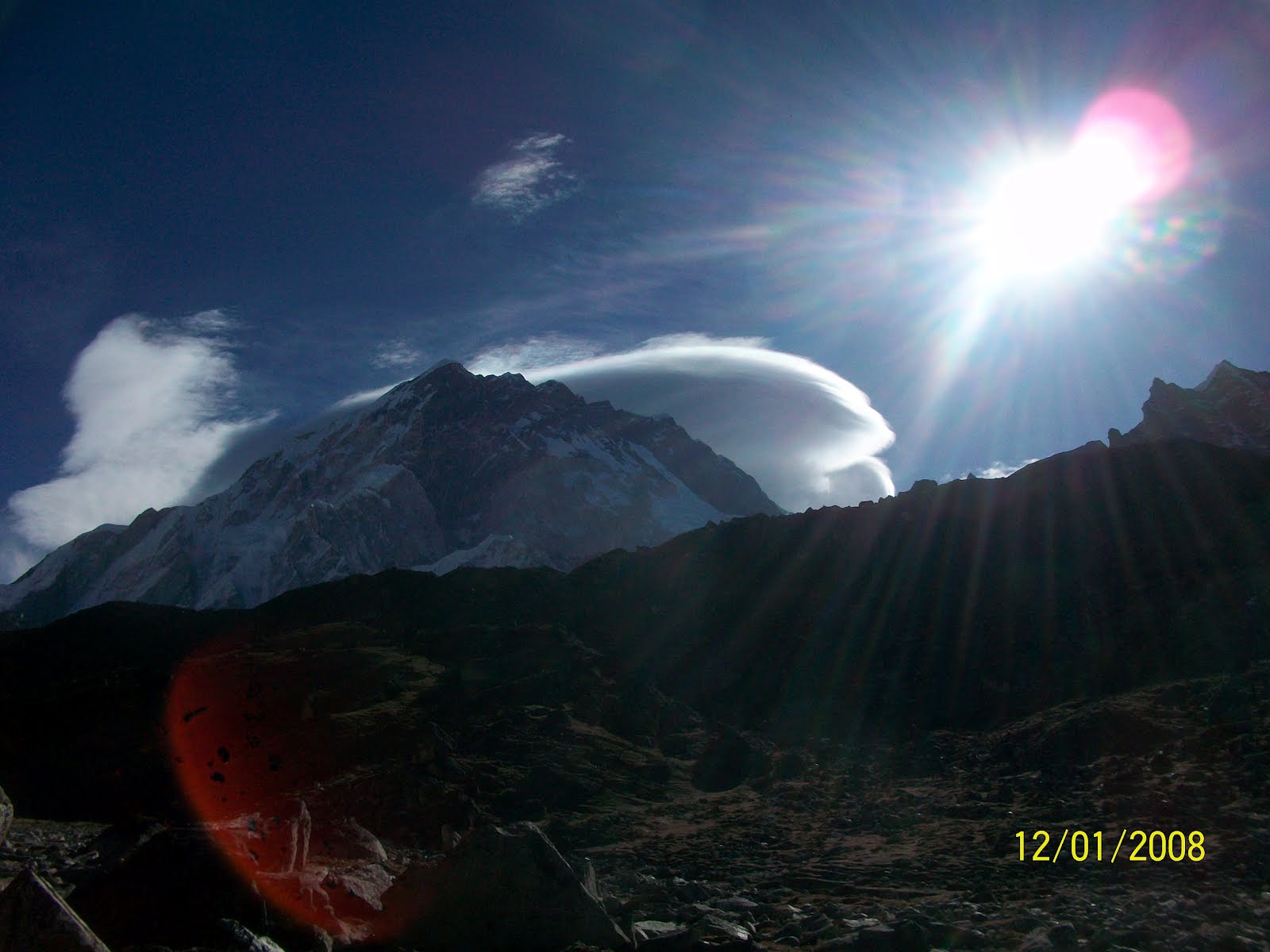
This is a "lenticular" cloud surrounding Mount Nuptse. Lenticular means "shaped like a lens." These clouds are found at high altitudes.
This is a view of Mount Everest from Kala Patthar (18,500 feet), our highest point on the trek. Everest, seen faintly between the two clearer peaks, is often shrouded in clouds.
This photo was taken atop Gokyo Ri (17,500 feet), another high point on the trek. Mounts Everest, Lhotse and Nuptse are in the background.
This is one of the dozen or so steel suspension bridges we crossed. While they look dangerous from a distance, I thought the were very safe.
This is a Hindu temple in Durbar Square in Kathmandu. The "pagoda" style architecture originated in Nepal.
Thursday, April 19, 2012
Himalaya High
My three week trek in the Himalayas came to an end two weeks ago and the magnificence and majesty of these mountains is still sinking in. Sometimes, my time there seems like a distant dream and I wonder, "Was I really there?"
I have so many amazing memories of this trek, it's somewhat overwhelming. Yesterday, I finally got around to downloading the photos from my camera and took some time reliving the people, places and scenery. The photo above is atop Goyko Ri, a 17,500 peak where you can see Mount Everest, Lotse and Nupse in the background.
Over a week of this trek was spent above 15,000 feet in altitude. I've only been above that altitude once (in Peru) and spending so much time that high was challenging in terms of eating, sleeping and breathing.
Even with these challenges, spending this time in the "rooftop of the world" was exhilarating. I don't believe I could ever get tired of seeing these giants of mountains towering over us. When we were at our highest point, Kala Patthar (18,200 feet), Everest still loomed above, more than 10,000 feet higher!
This was definitely a high point in my life and, literally, an authentic "mountaintop experience." These kind of experiences can feed one's soul for months and even years. Time will tell how long this high will last-- right now, I'm just enjoying it.
Labels:
Himalayas,
Mount Everest,
mountaintop experience,
trek
Friday, February 10, 2012
The Language of Poetry

I'm in the midst of writing a Bible study book on three New Testament letters: Ephesians, Philippians and Colossians. I just finished writing chapter 11 that is based on Colossians 2:6-15. The focus of this passage is what it means to "live in Christ."
The author uses several images to convey the reality of living in Christ. He uses an agricultural image (rooted), an architectural image (built up), a gastronomical image (filled) and a religious image (buried/raised). Each of these images captures a different aspect of one's relationship with Christ.
Each of these images is a metaphor. When our prose language comes up against its limitations, we are forced to use the language of poetry: metaphor,symbol, and image. Poetry is concentrated language that can convey many levels of meaning in a single word or phrase. For example, the Yin-Yang symbol above expresses far more than words can capture.
I believe that most religious language is metaphorical. When we attempt to describe that which is beyond description, we must use metaphors. This is true of our language about God and about our relationship with Christ. Whenever we talk about the spiritual dimension of life we use metaphorical language.
Once we acknowledge the metaphorical nature of religious language, we are freed from a misplaced literalism about things spiritual. Also, metaphors and images can convey the richness, depth and power of the sacred realm.
Wednesday, January 18, 2012
"99%+1%=110%"

I wrote my weekly Pastor's Word on the above topic. Here's what I wrote:
"For the past several months the cries of, “We are the 99%!” have echoed from Zuccotti Park to Berkeley. The Occupy Wall Street movement has made us more aware of the inequalities that exist in our society and has expressed justifiable anger over them.
"While this division between the 99% and the 1% is a dramatic illustration of income inequality, there is danger in demonizing everyone in the 1% as arrogant and uncaring. There are several members of the 1% who support one or more of the goals of OWS including President Obama, former President Bill Clinton and billionaire Warren Buffett.
"It occurs to me that the 99% and 1% need each other. The 1% need to hear the challenge to work for a more equal society, including accepting higher taxes. The 99%need the financial and political power of the 1% to change society. When the 99% and the 1% work together for a more just society synergy is the result. That’s why 99%+1%=110%."
A further comment... There is also danger in demonizing the OWS movement as a bunch of disorganized flower children who are stirring up class warfare. As I said above, the 99% and the 1% are interdependent. Each needs the other to accomplish any real or lasting change. I believe that most of us want a society where the values of compassion, justice and equality are embodied. We want equal opportunity for our children, especially our daughters and wives, and equal justice as well.
We need to get past labels and divisions to work together on common goals and changes. I may be an idealist, but I believe such cooperation is possible.
Labels:
change,
interdependence,
OWS,
society
Wednesday, January 4, 2012
No Guarantees

The beginning of a new year often puts me in a reflective frame of mind. I look back over the year just past and think about opportunities seized (and missed), new relationships started (and ended), and successes (and failures).
I also think about the upcoming year and its prospects. What do I hope to do (and refrain from doing)? What goals will I reach (or fall short of)? What changes will happen to me and what changes will I make (or fail to make)?
One certain truth when it comes to the future is this: there are no guarantees. Health, success, prosperity aren't guaranteed. Neither is life.
We live and act as if we know for certain that we will be alive to enjoy tomorrow, next month or next year. Yet, we don't know, and can't know, what the future holds.
Accepting that we are always moving into an uncertain future isn't easy. It means giving up the illusion that we can control what happens to us and to those we love.
Yet, once we accept this truth, we are free to live and love more fully. As long as we labor under the delusion that we can control the future, we will be continually frustrated and even unhappy. Accepting the uncertainty inherent in life is to recognize that life is a gift with no guarantees.
Wednesday, December 28, 2011
Marriage Mutuality

I'm in the midst of writing an adult Bible study book on Ephesians, Philippians and Colossians. Right now, I'm working on Ephesians 5:21-33. This passage includes these words, "Wives, be subject to your husbands as your are to the Lord. For the husband is head of the wife just as Christ is the head of the church..."
Unfortunately, these words have been taken out of their context to "prove" that women should be submissive to men in marriage and to argue for male superiority in marital relationships.
Yet, nothing could be further from the truth if the entire passage is read. The passage begins, "Be subject to one another out of reverence for Christ," and continues, "Husbands, love your wives, just as Christ loved the church and gave himself up for her...husbands should love their wives as they do their own bodies."
What is being presented here is mutuality in marriage. No member of the marriage partnership is superior to the other. Each is being called to treat the other with respect, dignity and self-giving love.
Granted, these words are put in the terms of a patriarchal society of the first century. That makes it even more amazing that marriage is seen in term of mutuality instead of male dominance.
Passages like the one cited above show why it is so critical to not take biblical verses, sentences or ideas out of their larger context. Doing this is called "proof texting" and is a way of getting the Bible to support a position already taken. You can literally make the Bible say nearly anything you want by this method. That's why we need to allow it to speak its own truth.
Wednesday, December 21, 2011
Christmas Blues

As a pastor, I've become increasingly aware that the Christmas season isn't a time of joy for everyone. Cries of "Merry Christmas" or "Happy Holidays" and upbeat carols can't always overcome feelings of sadness, isolation or grieving. This is especially true if we have suffered the loss of a loved one around Christmas time.
The cultural myth we labor under is that "everyone else is having a great time at Christmas." This can heighten feelings of sadness and isolation. Yet, for many, Christmas is a stressful time of shopping and card sending deadlines. Holiday gatherings with family members can be difficult and challenging. W.H. Auden admitted in his poem, For the Time Being: A Christmas Oratorio, to "Having tried, quiet unsuccessfully, to love all of my relatives..."
Also, there are those who feel depressed during the darker and colder months of winter. Seasonal Affective Disorder (SAD) is a documented psychological disorder. That's why most "Blue Christmas" services take place on the Winter solstice, the longest night of the year.
So tonight, I'm participating in a Blue Christmas service. This is a service of solace and comfort for those who find the Christmas season difficult or depressing because they are grieving for a loss or feel alone and isolated. This service acknowledges that Christmas can be a difficult time and offers hope to the disconsolate and grieving.
For those of us who are having a merry Christmas, let's not forgot those who aren't. Christmas can be a time of reaching out to those who need a word of comfort and solace.
Labels:
Blue Christmas service,
Christmas,
SAD
Thursday, December 8, 2011
Sacred Drumming

Last night I experienced the spiritual practice of drumming for the first time. What an amazing experience it was! The context for the drumming was a Wednesday evening Advent service at the church where I serve as interim pastor.
Our drumming leader, Jenifer, has been practicing spiritual drumming for 20 years. She explained how drumming can focus our thoughts and prayers in a rhythmic way. Drumming can be a form of meditation where the beating of drums shuts out all distractions.
In preparation for our drum circle we heard excerpts from a reading by Layne Redmond: "Handheld drums are among the oldest known musical instruments... The rituals of the earliest known religions evolved around the beat of the drum... It remained a powerful tool for communal bonding and individual transformation..."
Jenifer started playing her drum in a heartbeat-type rhythm and the rest of us joined in. After a few minutes I was lost in the beating of the drums as they blended together in a kind of melody and harmony at the same time. We played for a little over 10 minutes and it felt like just a few seconds had passed.
It's good to be open to new spiritual practices and I'm so glad I was able to experience sacred drumming. Life has its own hidden rhythms and drumming is a way of connected with those rhythms deep within our souls. When we are able to connect with these, we are more able to follow the drumbeat of God's spirit.
Wednesday, November 30, 2011
A Prayer for Openness

The following is a prayer based on Ted Loder's, "Gentle Us Open," from his book, My Heart in My Mouth.
Lord of life and light,
Help us not to fall in love with the darkness that separates us from you
And from each other.
But to watch with wide yes, open hands and eager minds for your Word.
Let us dream and hunger and pray for the light of you and the life
for each other.
Lord, in the midst of our white-knuckled busyness in this season,
We realize deep within us that your gifts of mercy and light, peace and joy,
grace upon grace, can only be received if we are open and receptive.
So this is our prayer, Lord. Open us. Pry us open any way you can. Shock, beguile, knock, amaze, squeeze any way you can open us.
Open us to see your glory in the coming again of the light of each day,
The light in children's eyes and lovers' smiles, the light of truth wherever
it is spoken and done.
Open us to the songs of angels in the rushing traffic, the rustle
of shoppers, in the hum of hope and the longing within each of us,
In the cries of our brothers and sisters for justice and peace, and in
our own souls' march toward goodness.
Open us to share the gifts you have given us, and to the deep yearning to
share them gladly and boldly. Open us to initiate the exchange of
forgiveness, to risk a new beginning free of past grievances, and to find
the gifts of a larger love and deeper peace,
Open us, Lord, to the miracles of the ordinary,
To the heart-pounding wonder of birth,
To a mother's fierce love and a father's tender guidance.
Open us so that we may born anew in the fullness of your image,
The fullness of a just and joyful human community,
The fullness of your kingdom,
In the fullness of time.
Amen.
Thursday, November 17, 2011
"Biblical Proportions"

While reading a New York Times article on the unusual weather we've been having this year, I came across the phrase "biblical proportions." This phrase was used to describe the October 29 freak snow storm that knocked out power to over 2 million homes on the East coast.
So what are "biblical proportions"? They are huge, gigantic, enormous and immense. When something happens on a massive scale, the word "biblical proportions" describes its immensity.
I wonder what events from the Bible qualify for this two-word adjective. Certainly, the creation of the world decribed in Genesis would qualify, as would the Flood Story. Perhaps the deliverance of the Hebrews from Egypt in the Exodus might also be an event large enough to evoke a response of "biblical proportions."
In modern times, we would probably use "biblical proportion" to describe large-scale catastrophes such as the 2005 southeast Asian tsunami or Hurricane Katrina in 2006. Surely, the explosion of an atomic bomb would also qualify.
Yet, I wonder if this phrase causes us to focus too much on visibly spectacular events and causes us to miss significant things that happen on a small scale. Some believe that, when God acts in our world, massive displays are the result. However, we need not be so impressed by largeness of scale that we forget the "still small voice" in which Elijah heard God addressing him.
Our world and our lives are changed in both large and small ways. To limit God to events only of "biblical proportions" is to overlook the subtle ways that God is present in our world.
Labels:
biblical proportions,
God's presence
Friday, November 4, 2011
The Paradox of Newness

On November 1, I began a new venture as a part-time interim pastor. In any new venture, there is a mixture of excitement and anxiety. This is a paradox of newness: even though we welcome it, we also fear it.
I feel a sense of excitement about being a pastor of a congregation again. It's been three and a half years since I served a congregation and I've missed things about being a pastor. The main thing I've missed is the closeness you can enjoy in a church community. I have also missed preaching regularly.
There are some anxieties as well. After three years will I remember how to preach a decent sermon? How will I juggle my other two jobs (teaching and writing)?
Will I be pushed out of my "comfort zone" and will I be able to grow from this? Will I be a good leader for this particular congregation?
I don't believe there is any way around the paradox of newness. In any new venture there are things to be excited about and things that can stir up our fears. Being human means accepting this paradox. Feeling excitement and anxiety are signs that we are alive!
Tuesday, July 26, 2011
Being Prepared

I was watching a travel/cooking show last night and heard the phrase mise en place. Curious as to the meaning of this, I looked it up. It means, "putting in place" and refers to a chef getting everything ready before he or she begins to cook. All of the chopping, dicing and cutting needs to be done before a dish is assembled and cooked.
Just as it is in cooking, preparation is critical in life. Right now, I'm preparing my syllabi for the three courses I'm teaching in the fall. Such preparation allows me to know what topics I'm going to cover and lets the students know what they need to read to be prepared for class.
Preparation is also important in the spiritual life. In the context of spirituality, preparation involves being open and receptive to the sacred dimension of life. How do we prepare ourselves to be receptive? One way is to have times of silence built into our daily schedules. Silence may be the best way to prepare ourselves to be open to the sacredness of the world around and the world within.
There are surely other ways of being prepared in a spiritual sense. Some prepare themselves by reading a sacred text or by reflecting on a specific concept or idea. I find that anticipation and expectation are important ways to be receptive to the spiritual dimension of life that continually surrounds us. We can find a connection with this dimension if we have the eyes to see, the ears to hear and the heart to perceive.
Monday, July 18, 2011
Land of Fire and Ice
I recently returned from 8 days in Iceland. It's a place I've wanted to visit since I was 12 years old. My desire to see this unique place was inspired by Jules Verne's novel, Journey to the Center of the Earth. I saw the volcano across the bay from Reykjavik where Verne's characters began their decent into the earth's center.
Iceland is truly a place of fire and ice. There are 22 active volcanoes on this large island. In the past year, two eruptions have disrupted air travel in Europe because of volcanic ash. There are numerous glaciers as well, some of which are covering volcanoes. This means an eruption usually causes flooding and icebergs crashing into bridges and homes.
I was part of a group doing a 4-day trek through an area described as "Yellowstone on steroids." We hiked on ash-covered snow for the first two days and were treated to steam vents created by boiling water. The landscape reminded me of the prehistoric land in "The Land that Time Forgot." The photo above shows what I mean.
Fire and ice can also serve as metaphors for the spiritual life. At Pentecost, fire is a symbol for the indwelling of God's spirit. At times, we need the fiery energy that the spiritual life can supply, giving us the motivation and purpose to give ourselves to a cause greater than self.
While ice can symbolize the absence of God, it can also be a metaphor for non-reactivity and detachment. Buddhism has often been called a religion of "a cool head and a warm heart." This combination of fire and ice can be powerful. At times, we need detachment from those things that cause anxiety and stress; at other times, we need engagement in an important venture. In short, we need both fire and ice in our spiritual life.
Tuesday, June 28, 2011
Cultivating A Beginner's Mind

I'm heading to Iceland on Friday for a week-long trek through a unique part of the earth called Laugavegur. This area in southeast Iceland has been described as "Yellowstone on steroids." It is characterized by geothermal activity such as geysers, hot springs, and volcanoes. It also features several glaciers. The photo above is from the official Iceland Tourism website.
When heading to a place I've never been, I have a sense of adventure and a feeling of anticipation. I feel open and alive to new possibilities and challenges. In Zen Buddhism there is a concept called "beginner's mind" (Shoshin). It refers to having a sense of openness, eagerness and a lack of preconceptions when approaching a topic of study. Cultivating a beginner's mind toward all subjects, even those that are very familiar, fosters deeper engagement and learning.
I'm going to Iceland with a beginner's mind, even though I've read three books on this country and think I know what to expect. I want to be open and receptive to all that this amazing place has to offer.
However, a beginner's mind is good to cultivate no matter where we're going or what we're studying. A sense of approaching something for the first time helps us to not prejudge and, therefore, keeps things new and fresh.
Subscribe to:
Posts (Atom)